
Peptide Lab HQ Research Guide
Thymosin Alpha-1
A research-focused compound profile covering Thymosin Alpha-1 identity, thymic peptide research, immune-modulation models, T-cell pathway context, concentration reference, reconstitution reference, and safety considerations.
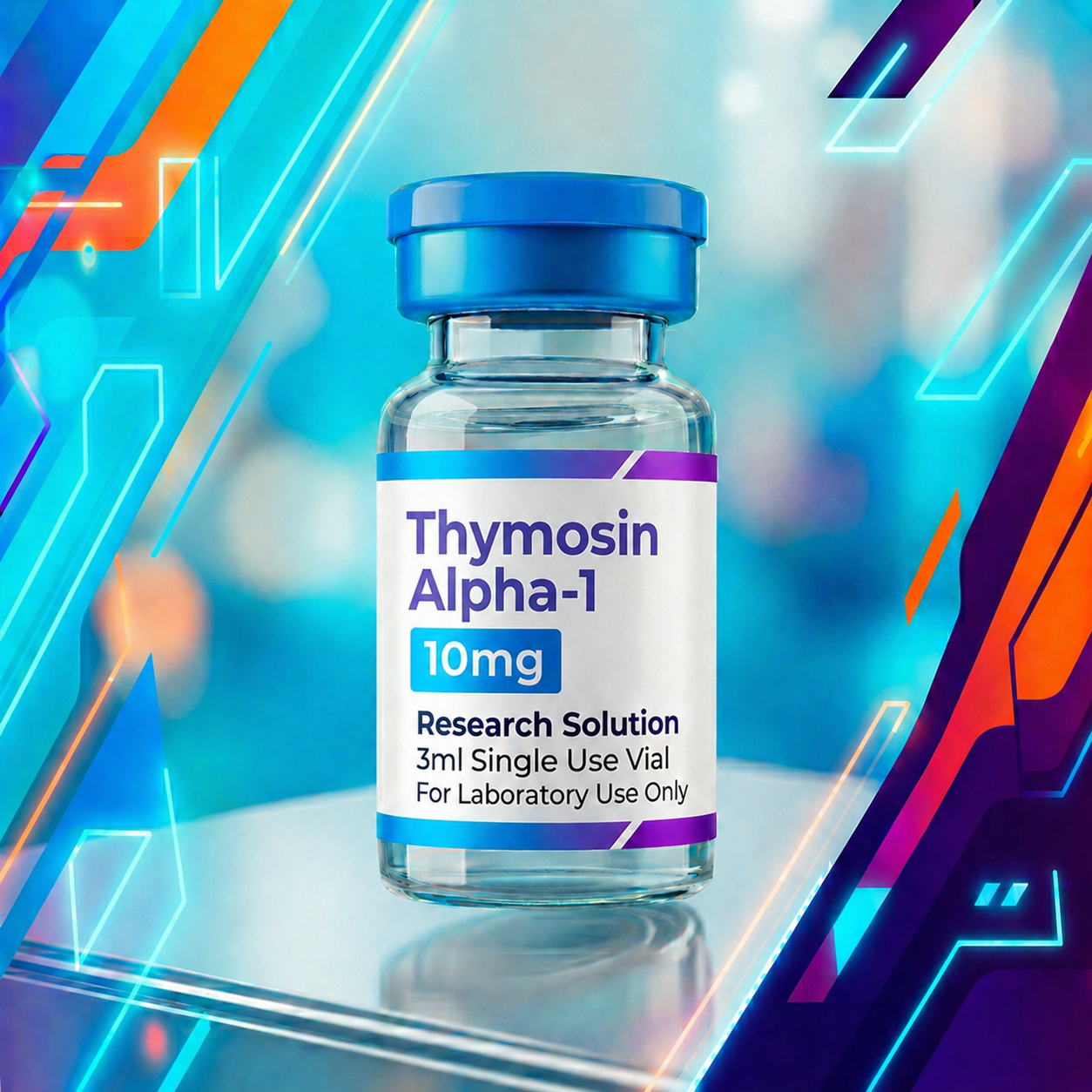
Compound Data
Compound Profile
| Compound Name | Thymosin Alpha-1 |
|---|---|
| Common Name | Thymalfasin |
| Common Synonyms | Ta1, Tα1, Thymosin α1, Thymosin Alfa-1, Thymalfasin |
| Compound Type | Synthetic thymic peptide / immune-modulation research peptide |
| CAS Number | 62304-98-7 |
| PubChem CID | 16130571 for Thymalfasin |
| Amino Acid Length | 28 amino acids with N-terminal acetylation |
| Amino Acid Sequence | Ac-Ser-Asp-Ala-Ala-Val-Asp-Thr-Ser-Ser-Glu-Ile-Thr-Thr-Lys-Asp-Leu-Lys-Glu-Lys-Lys-Glu-Val-Val-Glu-Glu-Ala-Glu-Asn-OH |
| Short Sequence | Ac-SDAAVDTSSEITTKDLKEKKEVVEEAEN-OH |
| Molecular Formula | C₁₂₉H₂₁₅N₃₃O₅₅ |
| Molecular Weight | Approximately 3108.3 g/mol |
| Research Category | Thymic peptide, immune modulation, T-cell response, dendritic cell signaling, TLR9 pathway context, vaccine-adjuvant, viral-response, and inflammation research |
| Appearance | White to off-white lyophilized powder, depending on salt form and supplier documentation |
| Use | For laboratory research use only. |
Research Applications
Key Research Applications
Thymosin Alpha-1 is commonly discussed in controlled research models involving immune-modulation pathways, thymic peptide signaling, T-cell response, dendritic cell activity, TLR9 pathway context, vaccine-adjuvant models, viral-response research, and inflammatory-response regulation.
Immune-Modulation Research
Thymosin Alpha-1 is commonly studied in research involving immune signaling, immune-cell communication, and immune-response regulation.
T-Cell Response Models
Used in research involving T-cell maturation, T-cell activation, thymic peptide signaling, and cellular immune-response documentation.
Dendritic Cell Research
Relevant to models involving dendritic cell activity, antigen-presentation context, lymphoid signaling, and immune-pathway coordination.
TLR9 Pathway Context
Thymosin Alpha-1 is discussed in literature and regulatory review material in relation to Toll-like receptor 9 pathway activity.
Viral-Response Research
Ta1 has been evaluated in clinical and preclinical research contexts involving hepatitis B, hepatitis C, and broader viral-response models.
Vaccine-Adjuvant Study Context
Thymosin Alpha-1 has been discussed in research involving vaccine-response markers, antibody titers, and immune-response enhancement models.
Research Scope
These applications are provided for educational and research-reference purposes only. Research outcomes may vary based on peptide form, salt form, purity, immune status, route, concentration, timing, and laboratory conditions.
Reference Only
Reconstitution / Research Dosing Reference
Select Reference Vial
Select a vial size to update the concentration, U-100 unit references, and frequency table below.
Quick Reference Summary
| Reference Vial | 5 mg Thymosin Alpha-1 |
|---|---|
| Primary Solution Volume | 2.0 mL bacteriostatic water |
| Primary Concentration | 2.5 mg/mL |
| Measurement Reference | On a U-100 syringe, 1 unit = 0.01 mL. |
| Amount per U-100 Unit | At 2.5 mg/mL, 1 unit equals 0.025 mg / 25 mcg Thymosin Alpha-1. |
| Storage Reference | Refrigerate at 2–8°C / 35.6–46.4°F after reconstitution, protected from direct light. |
Reconstitution Steps
- Draw 2.0 mL bacteriostatic water using a sterile syringe for the main concentration reference shown below.
- Slowly add the BAC water down the side of the vial wall.
- Gently roll or swirl the vial until the material is completely dissolved. The solution should appear clear. Do not shake!
- Label with compound name, vial amount, concentration, solvent volume, preparation date, storage conditions, and handling notes.
- Store refrigerated at 2–8°C / 35.6–46.4°F, protected from direct light.
Published Research Context
| Reference Type | Reported Amount / Context | Research Notes |
|---|---|---|
| Compound Identity Reference | Thymosin Alpha-1, also commonly referenced as thymalfasin or Tα1 | Thymosin Alpha-1 is commonly discussed as a thymus-derived 28-amino-acid peptide in immune-function and immunomodulatory research contexts. |
| Immune-Modulation Research | Model-dependent concentration and endpoint tracking | Commonly discussed in T-cell activity, dendritic-cell response, NK-cell response, cytokine-marker, and immune-homeostasis research models. |
| Antiviral / Host-Defense Research Context | Experimental and clinical-study context | Thymosin Alpha-1 has been discussed in research involving antiviral-response markers, interferon-pathway context, TLR signaling, immune activation, and host-defense marker documentation. |
| Dendritic Cell / TLR Research | TLR / MyD88 pathway and antigen-presentation context | Published research has discussed Tα1 in relation to dendritic-cell maturation, toll-like receptor signaling, antigen-presentation markers, and Th1-type immune response models. |
| Oncology-Adjuvant Research Context | Clinical-study context only | Thymosin Alpha-1 has appeared in clinical-study discussions involving immune-supportive oncology-adjunct contexts. These clinical-study references are not research-chemical dosing standards. |
| Public Protocol-Style Reference | Microgram-to-milligram reference examples | Public protocol-style references commonly describe Thymosin Alpha-1 in microgram-to-milligram examples depending on the research model and preparation format. These are not clinical dosing standards. |
| Clinical / Research-Chemical Status | No universal research-chemical protocol established | Published study references, clinical-study references, public protocol-style references, or wellness protocols should not be treated as dosing instructions for research-chemical vial formats. |
Concentration Reference
| Vial Amount | Solution Volume | Final Concentration |
|---|---|---|
| 5 mg | 2.0 mL | 2.5 mg/mL |
| 10 mg | 2.0 mL | 5 mg/mL |
Research Dosing Amount / Volume Reference
| Reference Amount | Volume at 2.5 mg/mL | U-100 Unit Reference | Approx. References per 5 mg Vial |
|---|---|---|---|
| 50 mcg | 0.02 mL | 2 units | 100 |
| 100 mcg | 0.04 mL | 4 units | 50 |
| 0.25 mg / 250 mcg | 0.10 mL | 10 units | 20 |
| 0.5 mg / 500 mcg | 0.20 mL | 20 units | 10 |
| 1 mg / 1000 mcg | 0.40 mL | 40 units | 5 |
| 1.5 mg / 1500 mcg | 0.60 mL | 60 units | 3.3 |
| 2 mg / 2000 mcg | 0.80 mL | 80 units | 2.5 |
| 5 mg / 5000 mcg | 2.00 mL | 200 units | 1 |
| 10 mg / 10000 mcg | 4.00 mL | 400 units | 0.5 |
Research Frequency / Amount Reference
| Research Window | Frequency | Reference Amount | Units / Volume Reference |
|---|---|---|---|
| Lower Microgram Reference | Calculation reference only | 50 mcg reference amount | 2 units / 0.02 mL |
| Standard Microgram Reference | Calculation reference only | 100 mcg reference amount | 4 units / 0.04 mL |
| Low Milligram Conversion Example | Public protocol-style reference, not a clinical dosing standard | 250 mcg reference amount | 10 units / 0.10 mL |
| Mid-Range Conversion Example | Public protocol-style reference, not a clinical dosing standard | 0.5 mg reference amount | 20 units / 0.20 mL |
| Standard Conversion Reference | Public protocol-style reference, not a clinical dosing standard | 1 mg reference amount | 40 units / 0.40 mL |
| Upper Conversion Example | Calculation reference only | 1.5 mg reference amount | 60 units / 0.60 mL |
| High Conversion Example | Calculation reference only | 2 mg reference amount | 80 units / 0.80 mL |
| 5 mg Preparation Reference | Preparation-level calculation reference | 5 mg reference amount | 200 units / 2.00 mL |
| 10 mg Preparation Reference | Preparation-level calculation reference | 10 mg reference amount | 400 units / 4.00 mL |
Common Research Windows
| Reference Window | Common Length | Research Notes |
|---|---|---|
| Cell-Culture / Immune Marker Window | 24–72 hours | May be used for T-cell marker, dendritic-cell marker, cytokine, TLR-pathway, antigen-presentation, or immune-response documentation depending on the model. |
| Acute Immune-Response Observation Window | Single session to several days | Used for short-term cytokine-marker comparison, dendritic-cell response, NK-cell marker tracking, or early pathway documentation depending on the research design. |
| Short Research Window | 1–2 weeks | May be used for early controlled observation involving immune-homeostasis markers, antiviral-response markers, T-cell response, or inflammatory-marker endpoints. |
| Standard Protocol-Style Window | 2–4 weeks | Commonly used in public protocol-style references for structured observation and comparison across baseline and follow-up periods. |
| Extended Observation Window | 4–12 weeks | Used when longer documentation is needed for immune-marker trends, cytokine-marker comparison, host-defense marker tracking, or follow-up immune-response documentation. |
| Follow-Up / Washout | 2–8 weeks | Used to document post-study observations, marker return, delayed response patterns, or follow-up data depending on the research model. |
Research Note: These tables are provided for educational, research-planning, concentration, frequency-reference, and volume-reference purposes only. Thymosin Alpha-1, also referenced as thymalfasin or Tα1, is commonly discussed in T-cell, dendritic-cell, NK-cell, cytokine-marker, TLR-pathway, antiviral-response, immune-homeostasis, and immunomodulatory research contexts. The selector above updates calculations for 5 mg and 10 mg vial references, each reconstituted with 2.0 mL bacteriostatic water. Published study references, clinical-study contexts, and public protocol-style frequency references are not universal research-chemical dosing standards and should not be treated as dosing instructions for research-chemical vial formats. This information is not medical advice, dosing instruction, injectable-use guidance, or a recommendation for human or animal use.
Research Notes
Research Findings & Safety Notes
Research Findings
Thymosin Alpha-1 is commonly discussed in research involving immune modulation, T-cell response, dendritic cell signaling, TLR9 pathway context, viral-response models, vaccine-response markers, and inflammatory-pathway regulation.
Study Limitations
Thymosin Alpha-1 research includes clinical studies, immunology studies, viral-response models, vaccine-adjuvant research, and broader immune-response investigations. Findings should be interpreted according to study design, route, immune status, endpoint selection, and peptide form.
Safety Considerations
Research discussion should account for immune-modulating activity, injection-site response, formulation solubility, aggregation risk, peptide purity, sterility documentation, endotoxin limits, immune status, and qualified laboratory handling procedures.
Use Restriction
Not for human or animal consumption. Not intended to diagnose, treat, cure, or prevent any disease when discussed as a research-use material.
Related Supplies
Research Supplies
For research supplies, visit our affiliate partner and use code PLHQ10 to save 10% on your order.
Bacteriostatic Water
Commonly referenced in laboratory preparation workflows.
Research Syringes
Supply category for controlled laboratory research preparation.
Prep Supplies
Supporting supplies for clean handling, preparation, and documentation.
Lab Handling
Handling & Storage
Storage
Store materials according to product-specific requirements. Protect from excessive heat, moisture, and direct light.
After Reconstitution
Keep refrigerated after reconstitution unless otherwise specified by the product documentation.
Handling
Use appropriate laboratory PPE, clean handling practices, and qualified research procedures.
Documentation
Maintain batch details, COA records, preparation notes, and internal research documentation.